

打造大国外交“会客厅” 扩展互利共赢“鹏友圈” 2025年深圳接待外宾团组超400批 | 窗口周刊
“改革开放推动了社会、经济的发展,这对古巴来说是一个很好的参照。”去年9月,古巴共产党中央委员会第一书记、古巴国家主席迪亚斯-卡内尔到访深圳,在参观“大潮起珠江——广东改革开放40周年展览”时写下此般感悟。
深圳是改革开放后党和人民一手缔造的崭新城市,是中国特色社会主义在一张白纸上的精彩演绎。从昔日不为人知的小渔村,成长蝶变为现代化国际大都市,深圳也是我国坚定不移奉行互利共赢开放战略的重要窗口。

近年来,越来越多的国家元首和政府首脑将深圳作为访华的必选地和首站到访地,这座城市也一直以“中国特色大国外交会客厅”的姿态广迎天下宾客。数据显示,2025年,深圳接待外宾团组超400批,其中外国元首和政府首脑3位,外国副元首和政府副首脑13位。“十四五”期间,共有包括26位外国国家元首和政府首脑在内的超1200批重要外宾团组访深,深圳的国际吸引力和影响力持续提升。
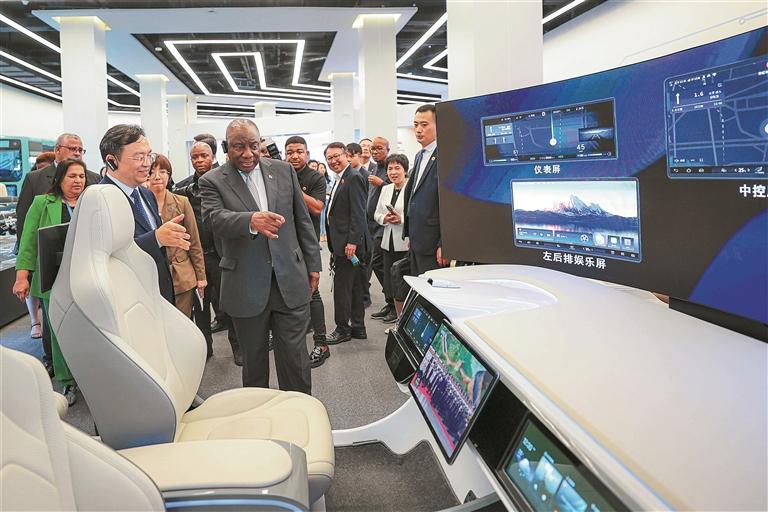
①南非总统拉马福萨一行参访比亚迪。 South African President Cyril Ramaphosa visits BYD.
中国式现代化的“实景体验馆”
2025年是深圳经济特区建立45周年。45年来,深圳地区生产总值从1980年的2.70亿元提升到2024年的36801.87亿元,年均增长18.8%,实现了历史性跨越,成为了中国式现代化成就的象征。
发展是时代的主题。深圳的发展奇迹无疑吸引着全球同样渴求发展的国家和地区的目光。
“你们为民营经济快速发展提供了哪些支持?”“如何创造好的营商环境?”……去年3月,越南副总理阮志勇一行访问深圳,带着问题深入了解深圳在民营经济、营商环境、科技创新等领域的发展经验,直言访问的主要目标就是“寻找越南经济发展新的动力”。
不久后,老挝副总理沙伦赛来深访问。通过与深圳市政数局、深智城集团等座谈交流,了解智慧城市建设的经验方法,沙伦赛相信“深圳将为老挝建设现代化城市提供宝贵经验”。
在去年8月至9月举行的深圳经济特区发展经验研修班上,来自亚洲和非洲十几个发展中国家的38名官员考察学习,希望从深圳的发展经验中汲取启示。
“我想写一份研究报告,概述深圳从起步到成功的过程,分享我们在深圳学到的经验。”肯尼亚橙色民主运动党中央办公厅新闻局局长菲利普说,肯尼亚仍是一个在工业化进程中的发展中国家,需要向其他国家或地区学习,例如深圳。
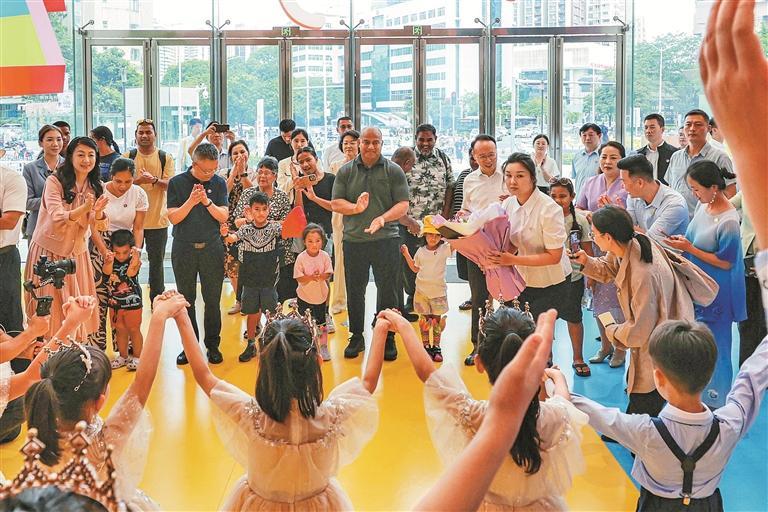
②瑙鲁总统阿迪昂来到深圳妇儿大厦,了解深圳为妇女儿童提供的暖心服务。 Nauru President David Adeang tours Shenzhen Women and Children’s Building.
探索合作共赢的“机遇聚合场”
“我真切感受到了顶尖的中国科技水平。”近日,国际奥委会主席考文垂在深圳参访奥林匹克全球合作伙伴TCL时说。
作为腾讯、华为、大疆等世界知名科技巨头的总部所在地,深圳被誉为中国“硅谷”和“南方科技中心”,已成为全球创新的重要引擎。这座“创新之城”的发展机遇,与全球伙伴在开放合作中共享。
2025年,哈萨克斯坦第一副总理罗曼·斯克利亚尔、新加坡副总理兼贸工部部长颜金勇、美国俄勒冈州参议院议长罗布·瓦格纳等多国高级官员先后访深,英国各地区市长代表团、德中友好协会联合会(ADCG)代表团等各类代表团也相继来访。“十分看好深圳的发展潜力,希望进一步加强全方位深入合作。”正如颜金勇所言,深化合作、共商机遇是各国外宾选择深圳的重要动因。
与此同时,高交会、文博会、全球招商大会等大型展会也成为深圳广邀天下宾客、拓展互利共赢合作的重要平台。2025年,高交会吸引了全球120多个国家和地区的国际组织、知名企业、行业精英参展参会,65个国家和地区参展的文博会也见证着国际化“朋友圈”的不断扩展。
展望今年,随着APEC进入“中国时间”,许多国际友人更对“深圳之约”充满期待。“中国未来投资与科技的风向,将很大程度上从深圳这里开始涌动。”
华南美国商会会长哈雷·赛耶丁说。
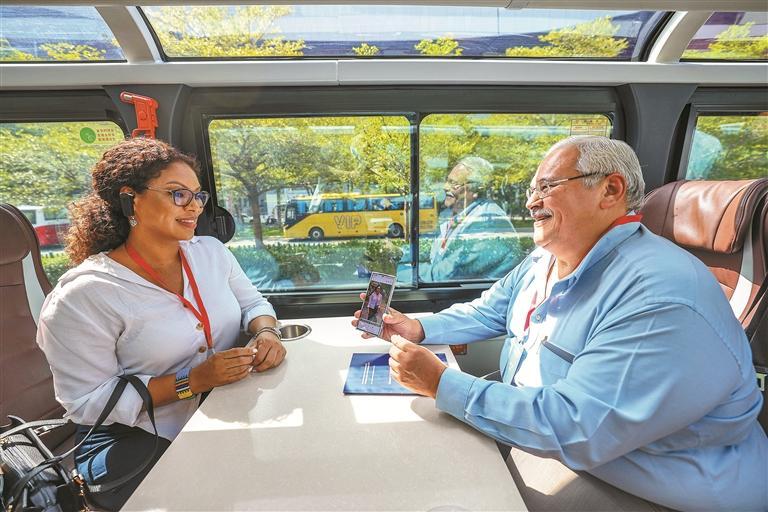
③国际嘉宾们乘坐“红胖子”双层观光巴士游览深圳。 International guests explore Shenzhen on a double-decker sightseeing bus. 本栏图片由深圳特区报记者 何龙 摄 Photos by He Long/ Shenzhen Special Zone Daily
多元人文交流的“互动实践场”
“匹克球拉近了我们之间的距离。”去年4月,“2025美国青少年匹克球人文交流中国行”代表团来到深圳,来自美国马里兰州蒙郡公立学校的学生不仅和深圳学生展开了匹克球友谊赛,还一起参与了射箭、纸艺、金箔画制作等活动,以体育教育交流为纽带,播下友谊的种子。
两个月后,“遇见湾区”中美青年创新探索交流营来到深圳,来自旧金山湾区的青少年通过机器人挑战、剪纸、话剧排演、共植“友谊树”等活动和深圳学生们互动交流。
人文交流日益成为联结世界各国的重要纽带。深圳这座青春之城、活力之城的人文之光和艺术之韵,也使其成为推动文明交流互鉴的绝佳平台。
2025年,第九届世界汉学大会在深举行,来自50余个国家和地区的近200位汉学家共商汉学在人工智能时代的创新发展之路;100+艺术季汇聚超百位国际艺术家,以交流联结亚太;深圳“一带一路”国际音乐季汇聚包括18个共建“一带一路”国家在内的30个国家的艺术团体和艺术家……
在文化交融互动中,搭建起民心相通的桥梁,也让世界透过深圳故事更好读懂中国。
During a visit to Shenzhen last September, Cuban President Miguel Díaz-Canel Bermúdez toured the exhibition “Great Tides Surge along the Pearl River: 40 Years of Reform and Opening Up in Guangdong.” He noted that China’s socioeconomic progress offers a valuable reference for Cuba.
Emblematic of China’s reform and opening up, Shenzhen is a city created by the Communist Party of China and the Chinese people — a striking embodiment of socialism with Chinese characteristics. Its rise from a small fishing village into a modern international metropolis showcases China’s commitment to mutually beneficial cooperation.
A growing number of world leaders now consider Shenzhen a must-visit destination in China. In 2025 alone, the city received over 400 foreign delegations, including three heads of state or government. From 2021 to 2025, it welcomed more than 1,200 foreign delegations, including 26 national leaders.
The year 2025 marks the 45th anniversary of the Shenzhen Special Economic Zone. Shenzhen’s GDP has soared from 270 million yuan in 1980 to 3.68 trillion yuan in 2024, achieving an average annual growth of 18.8%. This historic leap epitomizes China’s modernization.
This remarkable development draws keen attention from countries pursuing growth. During a visit last March, Vietnamese Deputy Prime Minister Nguyen Chi Dung focused on Shenzhen’s support for the private economy, business environment, and technological innovation, seeking insights for Vietnam’s development.
Similarly, Lao Deputy Prime Minister Saleumxay Kommasith explored Shenzhen’s smart city initiatives, noting the city’s achievements “can provide Laos with valuable lessons for building modern cities.”
From August to September last year, 38 officials from Asian and African developing countries attended a seminar on Shenzhen’s development model.
“I plan to write a research report outlining Shenzhen’s journey and sharing the lessons learned here,” said Philip Etale, communications director of Kenya’s Orange Democratic Movement party, noting Kenya can learn much from Shenzhen.
International Olympic Committee President Kirsty Coventry, after visiting TCL, remarked, “I truly witnessed world-class Chinese technology.”
Home to tech giants like Tencent, Huawei, and DJI, Shenzhen is hailed as China’s “Silicon Valley” and a leading innovation hub, where partners worldwide can share opportunities through open cooperation.
In 2025, Shenzhen hosted high-level visitors including Kazakhstan’s First Deputy Prime Minister Roman Sklyar, Singapore’s Deputy Prime Minister Gan Kim Yong, and President of the Oregon State Senate Rob Wagner, as well as a group of U.K. mayors and representatives from the Association of German–Chinese Societies. During his visit, Gan stated, “We are very optimistic about Shenzhen’s development potential and hope to further deepen all-round cooperation.” For such guests, Shenzhen has become a key destination for forging partnerships.
Major events like the China Hi-Tech Fair (CHTF) and the China (Shenzhen) International Cultural Industries Fair (ICIF) have become vital platforms for global engagement. In 2025, the CHTF drew participants from over 120 countries and regions, while the ICIF featured exhibitors from 65 countries and regions.
With the “China Year”now underway, global attention turns to Shenzhen for closer ties. “Shenzhen will be the primary source of China’s future investment and technological trends,”said Harley Seyedin, president of the American Chamber of Commerce in South China.
Last April, a U.S. youth delegation took part in a pickleball cultural exchange in Shenzhen, where students from Montgomery County, Maryland, played friendly matches with local peers and engaged in archery, paper art, and gold foil painting — building friendships through sport and culture.
Two months later, teens from the San Francisco Bay Area joined an innovation camp in Shenzhen, where they collaborated with local students on robotics challenges, paper-cutting, and drama workshops, and planted “friendship trees” together.
In 2025, Shenzhen hosted the 9th World Conference on Sinology, convening nearly 200 scholars from over 50 countries. The city’s art festival featured over 100 international artists, and the “Belt and Road” International Music Festival showcased performers from 30 countries, including 18 Belt and Road partner nations.
These vibrant exchanges build bridges of mutual understanding, helping the world see a dynamic, open, and innovative China through the story of Shenzhen.
(Translated by Li Jing)
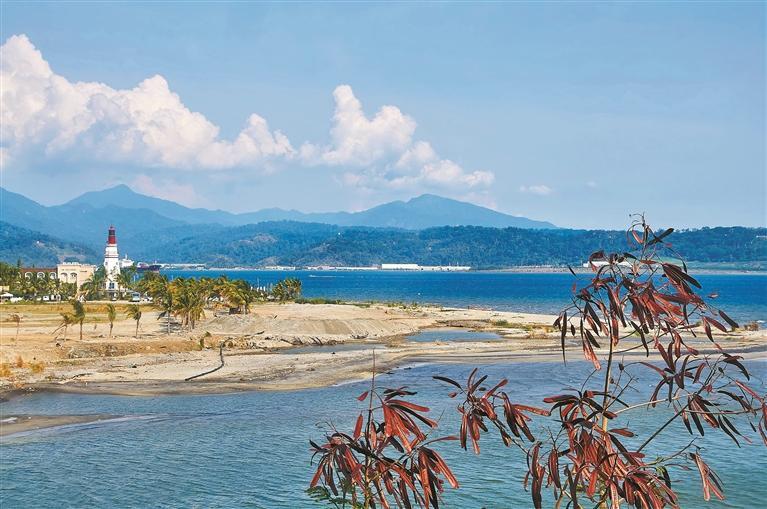
苏比克湾风光。(视觉中国) A view of Subic Bay. VCG
Shenzhen’s global pull: 400+ foreign delegations touch down in 2025
部长级会议
部长级会议包括年度双部长会议以及专业部长会议。双部长会议每年在领导人会议前举行一次。专业部长会议定期或不定期举行,包括贸易部长会、财长会、中小企业部长会、能源部长会、海洋部长会、矿业部长会、电信部长会、旅游部长会、粮食安全部长会、林业部长会、结构改革部长会、交通部长会、人力资源部长会、妇女与经济高级别会议、卫生与经济高级别会议等。
APEC Ministerial
Meetings
explained
The APEC Ministerial Meetings comprise an annual Joint Ministerial Meeting, held prior to the APEC Economic Leaders’Meeting, and various Sectoral Ministerial Meetings, which convene on a regular or ad-hoc basis to address areas including trade, finance, small and medium enterprises, energy, ocean affairs, mining, telecommunications, tourism, food security, forestry, structural reform, transportation, human resources, women’s economic participation, and health.
第四站:菲律宾苏比克
1996年,亚太经合组织第四次领导人非正式会议在菲律宾苏比克湾举行。此次会议确立了以自主自愿、协商一致为特点的APEC合作方式,呼吁各方给予经济技术合作应有的重视,并把私营部门纳入APEC进程。
苏比克湾位于菲律宾吕宋岛西南部,南临中国海,距马尼拉西北约100公里。港湾长14公里,宽8—13公里,水深24—50米,拥有深水良港和天然锚地。美军曾在此建设军事基地,1991年美军撤离后,菲律宾政府将其成功转型为一个现代化商业与工业自由港区。
Fourth Stop:
Subic Bay,the Philippines
In 1996, Subic Bay in the Philippines hosted the fourth APEC Economic Leaders’ Meeting, a milestone that formalized APEC’s cooperation model — characterized by voluntary, consensus-based decision making — called for greater emphasis on economic and technical cooperation, and formally integrated the private sector into APEC’s work.
Subic Bay is situated in southwestern Luzon, facing the South China Sea to the south, and lying approximately 100 kilometers northwest of Manila. The bay extends 14 kilometers in length and 8-13 kilometers in width, with depths of 24 to 50 meters, offering a natural deep-water port and sheltered anchorage. Once home to a major U.S. military base, the area was successfully redeveloped into a modern commercial and industrial freeport after the U.S. forces departed in 1991.
加快建设现代化 国际大都市
2025年3月,《关于加快建设现代化国际大都市的工作方案(2025—2027年)》以市委2025年1号文件印发实施,提出以全面提升深圳在全球的知名度、显示度和美誉度作为行动导向,围绕推动高质量发展、创造高品质生活、建设高水平现代化国际大都市进行谋篇布局。
方案提出,深圳将健全全场景全链条涉外服务体系,聚焦高频国际化服务场景,在重点商圈、景点、酒店、口岸、交通枢纽、政务服务窗口、医院、银行、学校等领域集中推出一批国际化建设样板,通过提高外语服务能力、优化涉外服务流程、提升环境舒适友好度等举措,打造国际化服务示范标杆,提炼可复制可推广的经验模式。
Shenzhen fast-tracks rise as global city
In March 2025, Shenzhen unveiled a three-year plan to accelerate its development as a modern international metropolis. The blueprint aims to boost the city’s global visibility, prominence, and reputation by promoting high-quality development and improving living standards.
As per the plan, Shenzhen will upgrade its comprehensive foreign-related service system by piloting internationalization projects in key areas such as business districts, tourist sites, transportation hubs, hospitals, and schools. By strengthening multilingual support, streamlining service procedures, and creating a more welcoming environment, Shenzhen seeks to set new standards for international services and build replicable models for other cities.
编辑 白珊珊 审读 秦天 二审 党毅浩 三审 万晖