
去公厕最好少碰这4样东西!比马桶还脏,而你却经常用
1. 该内容开篇排版了14张来源于佛山+资源站点的相关主题配图,图片统一居中展示并设置了最大宽度限制。 2. 该内容的核心文字部分为8篇与卫生间环境卫生、微生物传播相关的研究文献汇总。 3. 汇总文献涉及的研究方向包括马桶冲水微生物气溶胶生成传播、公共卫生间微生物污染、公共洗手液卫生质量、干手方式的微生物污染以及传染病经卫生间环境传播案例研究多个相关领域。







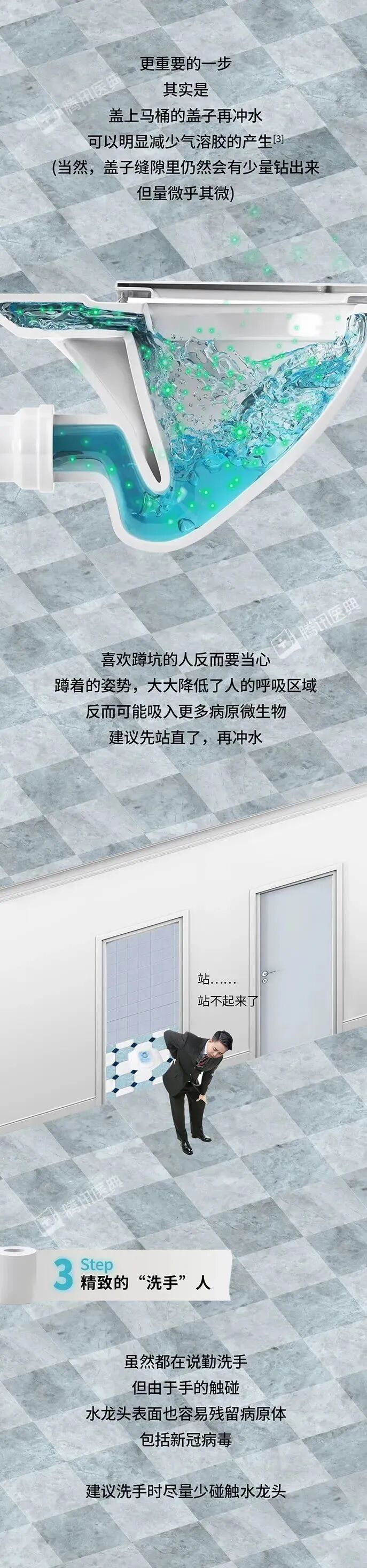






[1] 中国疾病预防控制中心,环境与健康相关产品安全所,毛怡心,等。马桶冲水行为与微生物气溶胶传播。微生物学报,2018,58 (12):2070-2077.
[2] Bound WH, Atkinson RI. Bacterial aerosol from water closets. A comparison of two types of pan and two types of cover. The Lancet, 1966, 287 (7451): 1369—1370.
[3] Schreck J H, Lashaki M J, Hashemi J, et al. Aerosol generation in public restrooms [J]. Physics of Fluids, 2021, 33 (3): 033320.
[4] 世界卫生组织公布香港淘大花园 SARS 传播的环境卫生报告 [J]. 环境与健康杂志,2003 (04):245.
[5] Suen L K P, Siu G K H, Guo Y P, et al. The public washroom – friend or foe? An observational study of washroom cleanliness combined with microbiological investigation of hand hygiene facilities [J]. Antimicrobial Resistance & Infection Control, 2019, 8 (1).
[6] Hong S B. Investigation of Bacterial Contamination of Liquid Soaps Used in Public Restroom [J]. Korean Journal of Clinical Laboratory Science, 2020, 52 (3): 214–220.
[7] 杨丽华,张永,赵锐,张冬莹,王萍。公共场所中洗手液使用现状及其卫生质量分析 [J]. 中国卫生检验杂志,2016,26 (19):2859-2860+2864.
[8] Best E L, Parnell P, Wilcox M H. Microbiological comparison of hand-drying methods: the potential for contamination of the environment, user, and bystander [J]. Journal of Hospital Infection, 2014, 88 (4):199–206.